NEWS
Crack in the Mess Hall: The Quiet Soldier Who Stood Up to a Furious Major
A dropped canteen silenced a crowded mess hall when a quiet newcomer stepped between a furious major and a terrified teen private.
By Ty
3 min read

The Sound That Stopped Lunch
The video opens in the middle of a busy lunch at Camp Vora. The air smells of polished floors and burned coffee, with nearly a hundred tired soldiers talking, forks clinking and boots dragging.
Then a single sharp sound cuts through it all — a canteen hitting the floor.
It belonged to Private Leo Miller, 19, shaking badly at the far end of the long steel table.
The story describes him as a young soldier sending nearly every dollar of his modest paycheck home to help his mother with medical bills. He squeezes his eyes shut, bracing for what comes next.
What comes next is Major Thomas Sterling, 45, broad-shouldered and permanently bitter. The narration paints him as an officer who survives on intimidation, his career stalled for years, taking comfort in the instant tension and fear that follows him into every room. He marches straight for Miller, face darkening.
The Stranger With No Name Tag
Sitting alone near the end of the table is the video's narrator — average height, quiet, forgettable in slightly faded standard-issue fatigues.
There is no name tag on her chest and no rank insignia anywhere, the normal look of a newly transferred holdover waiting for paperwork to clear.
As Sterling begins shouting at Miller, she calmly stands and steps directly into his path, placing herself between the towering major and the terrified teenager. Her voice is low but perfectly steady: “He dropped a canteen, Sir.
It was an accident. There’s no reason for this to go any further.”
Sterling stops cold. Veins rise along his thick neck. A nameless, rankless nobody has just told him how to handle one of his own soldiers.
He leans in close, stale tobacco on his breath: “What exactly did you just say to me?” She holds his eyes without moving back: “I said there’s no reason to escalate this, Major.”
A Crack Like a Gunshot
That refusal to blink or retreat pushes Sterling past restraint. What he sees is not composure, but disrespect.
With an angry shout he surges forward, locks a heavy hand around the back of her head and, using his full weight, forces her downward.
The sound of her face hitting metal cracks through the mess hall like a gunshot. Her face strikes the aluminum meal tray. Mashed potatoes, thick brown gravy and Salisbury steak explode across the tabletop and spill onto the spotless linoleum.
Sterling holds her there, one palm pressed firmly on the back of her neck, shouting: “GET OUT! You do not speak to me! You do not stare at me! You are nothing but dirt under my boots!”
The first still captures that moment — Sterling bent low over her bowed head, mouth open in rage while other soldiers blur in the background. Shock sweeps the cafeteria.
Behind the serving counter, Brenda, the civilian cook who has fed soldiers there for nearly two decades, gasps and lifts her apron to her mouth.

Sergeant Hayes, a ten-year veteran who can quote regulations from memory, shifts half a step forward. His pulse hammers.
He knows this is assault and a violation of military justice — then stops, eyes dropping to the floor, jaw tight with shame, unwilling to risk his pension against Sterling’s reputation for ruining challengers.
Held Down as an Example
Sterling wants everyone to see it. This is no longer punishment, the narration says, but a display.
He looks around his mess hall with mockery: “You think you can walk into my mess hall and pretend to be some kind of hero?
I’ll destroy your career until you’re cleaning toilets with a toothbrush for the rest of your miserable life.”
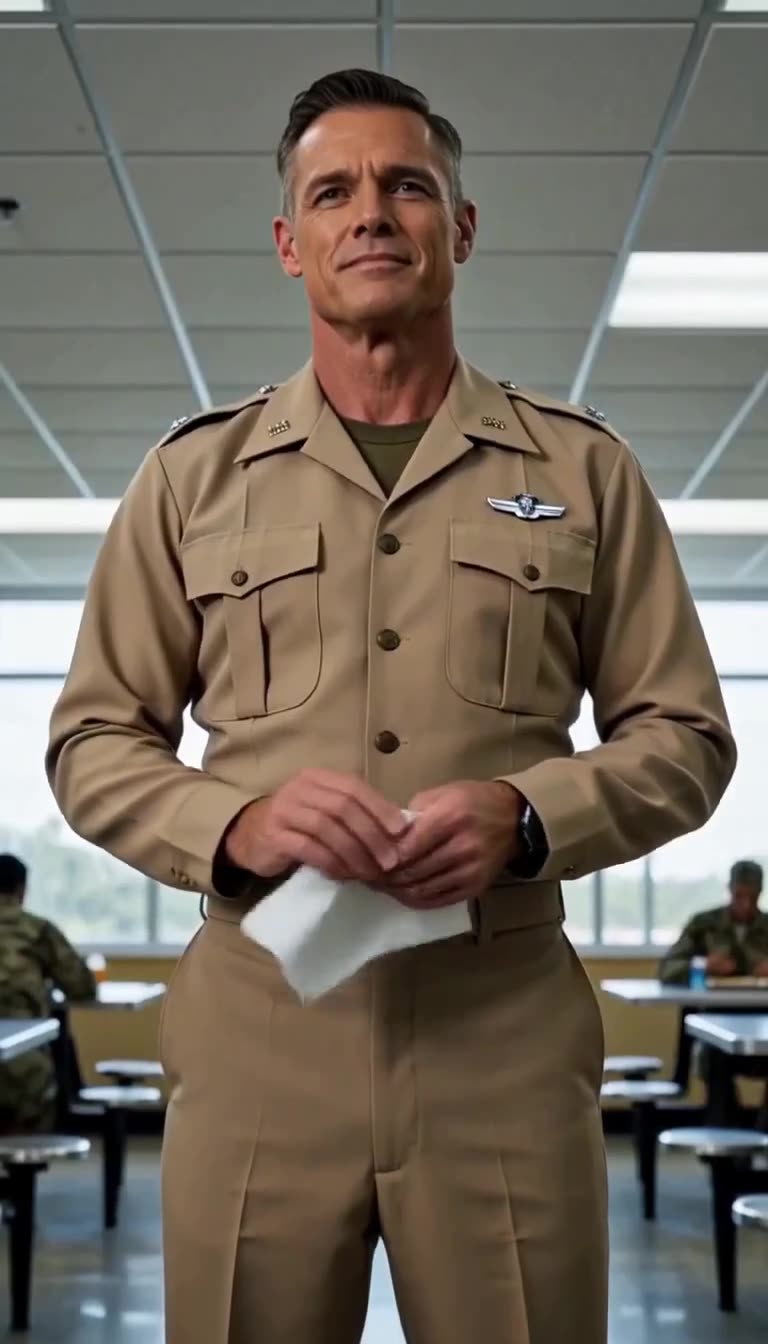
At last he lifts his hand and steps back. The second still shows him standing upright again in his tan service uniform in the middle of the tables, holding a napkin, composed and almost pleased.
He wipes a streak of gravy from his polished shoe, adjusts his collar and takes a deep breath: “Now stand up and get out of my sight before I throw you into the stockade.”
A heavy silence settles. Slowly, almost deliberately, she pushes herself upright. Gravy slides from her chin and soaks into her collar. A bright red mark spreads across her forehead.
The final close-up holds on her face in camouflage — stunned, breathing hard, but still looking back and speaking, refusing to disappear.


